City guide · Marwar, Rajasthan
Jodhpur
The Blue City
In 60 seconds
Jodhpur is a city in Rajasthan, India, and the historic seat of Marwar — founded in 1459 beneath the Mehrangarh Fort, and known as the Blue City for the blue-washed houses of its old quarter.
In 1459, Rao Jodha moved his capital from Mandore to a bare rock roughly 120 metres above the plain — and Marwar never looked back.
The city that grew beneath Mehrangarh Fort painted itself blue, traded opium, silk and sandalwood on the caravan routes, and became one of the most powerful kingdoms in Rajasthan.
FOUNDED
1459
by Rao Jodha of the Rathores
BEST TIME
Oct – Mar
RIFF folk festival in October
GIVE IT
2 – 3 days
two full, three unhurried
GETTING IN
JDH
daily flights & overnight trains from Delhi
The Story, in Five Acts
The full telling lives in the 32-page guide
THE CURSE · 1459
Mandore, the old capital, had proven impossible to hold, so Rao Jodha moved his seat to a hill of birds — evicting the hermit who lived there. The story goes that the old man cursed the rock with drought, and that a villager, Raja Ram Meghwal, volunteered to be buried alive in the foundations to soften it. What is certain: the crown honours his family's land to this day.
THE LAND OF DEATH
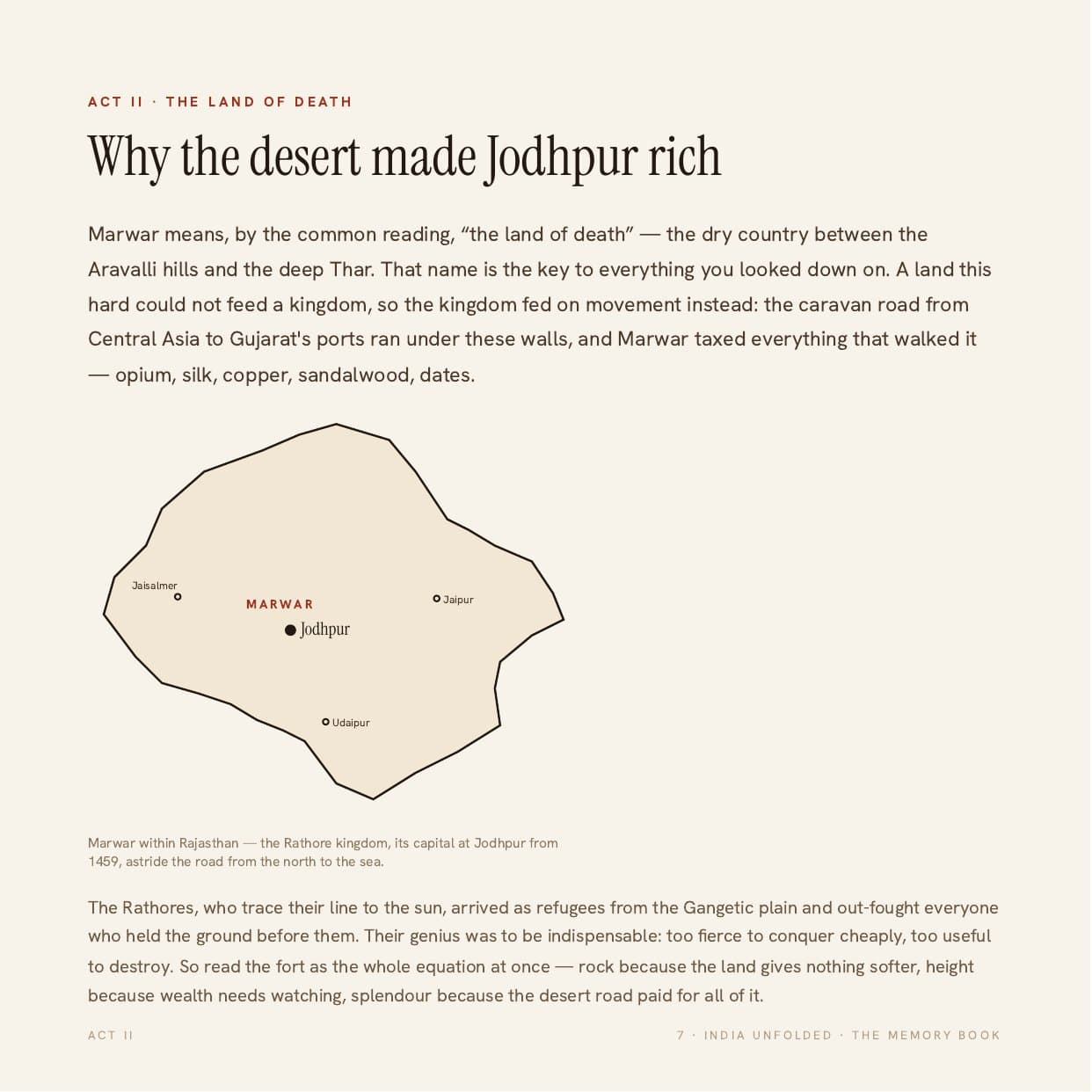
Marwar means, by the common reading, “the land of death” — yet the desert made Jodhpur rich. The city sat astride the caravan road from Central Asia to Gujarat's ports, taxing opium, silk, copper, sandalwood and dates as they passed beneath the walls.
A HANDFUL OF MILLET · 1544
Sher Shah Suri took Marwar — at such a price he is said to have muttered that he had nearly lost the empire of Hindustan “for a handful of millet.” The Rathores took their desert back within a year of his death.
THE BREECHES & THE RAJ · 1818
A treaty kept the throne under the British. Jodhpur's riding cut was adapted here from the churidar and carried to London in 1897 by the regent Sir Pratap Singh, where British tailors took it up — and “jodhpurs” entered the world's wardrobes. When famine struck in the 1920s, the palace of Umaid Bhawan was begun in 1929 and built largely to employ two to three thousand of the starving, for fourteen years.
THE LIVING CITY · 1947 —
Jodhpur joined the Union; the royal family stayed on in half a palace-hotel. Mehrangarh became a museum run by the family trust — and when Hollywood needed a fortress beyond imagining, The Dark Knight Rises came here to film.
Look Closer™ · Mehrangarh Fort
Stand here. Look for this.
What the plaques won’t tell you — and where to stand to see it for yourself.
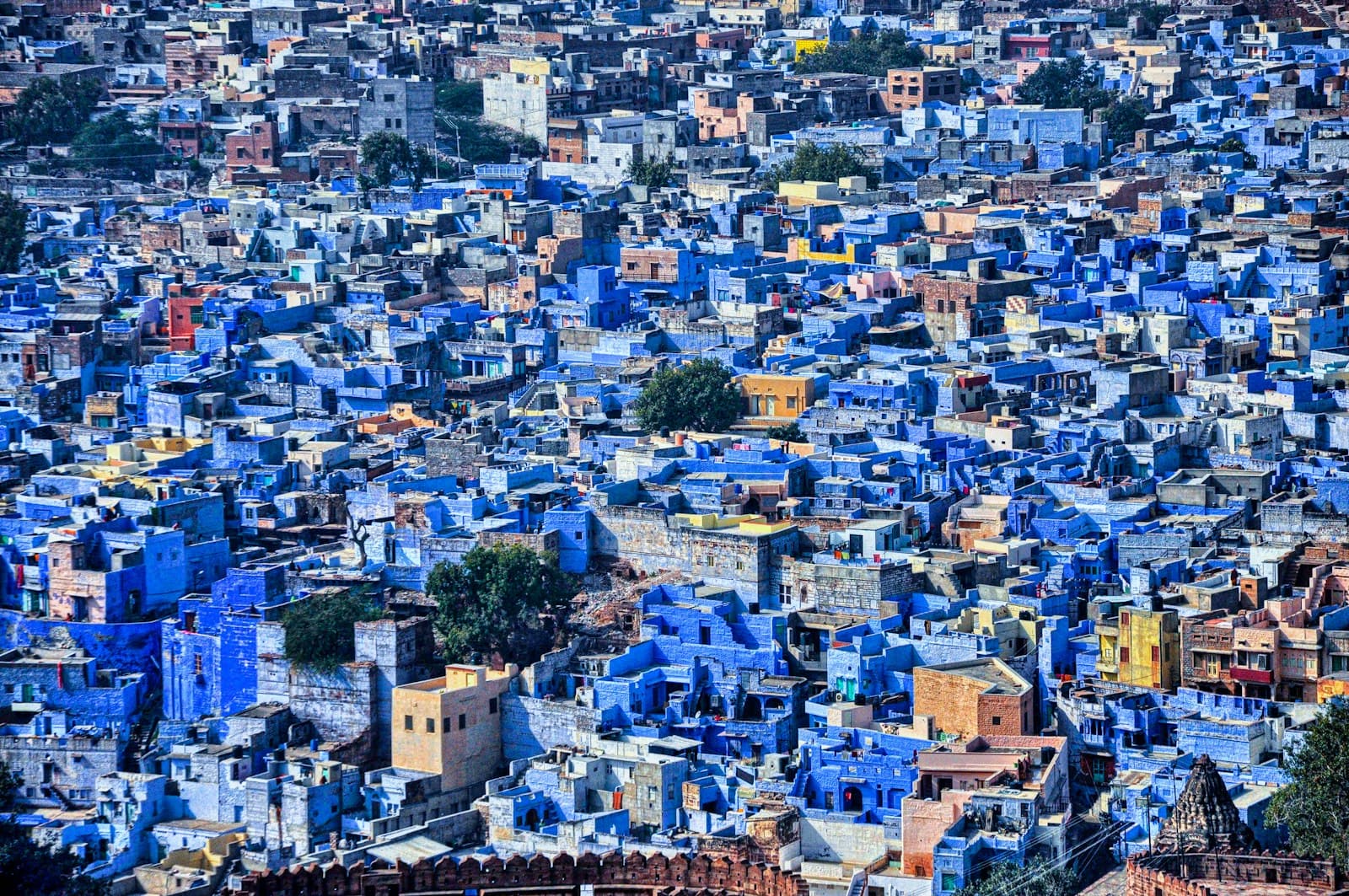 ← LOOK HEREPhotograph by Abhinav Tripathi
Navchokiya, below the fort's west face · before 9am
Nobody knows why it's blue
Lanes where every wall is indigo — and, on most of them, the drip-line of this year's fresh coat.
WHY IT MATTERSBrahmin caste-marking, copper-sulphate termite proofing, indigo's cooling chemistry — the theories contradict each other. The explanations conflict. We separate what is documented from what remains local tradition.
Loha Pol · the left-hand wall beside the gate, at palm height
The handprints by the gate
A row of small handprints pressed into the stone, smeared with vermilion and often garlanded.
WHY IT MATTERSSati marks — traditionally attributed to the widows of Maharaja Man Singh, who died in 1843, pressed on their way to the pyre. Most visitors walk past without seeing them.
Dedh Kangra Pol · the old gate behind Jai Pol, and the wall beside it
The unrepaired scars
Round, pocked impact marks in otherwise dressed masonry around the gateway.
WHY IT MATTERSCannonball strikes from the Jaipur-led siege of 1807 — a war fought over which king would marry Krishna Kumari, a princess of Mewar. In 1810 the sixteen-year-old was poisoned by her own family to remove the cause; Tod's telling has her drinking it willingly. Man Singh built Jai Pol in front in 1806, before any of this, to mark an earlier victory over Jaipur and Bikaner; the scars on the older gate behind it were never repaired.
The ramparts, facing west · the last hour before closing
The fort of the sun
The walls take the colour of the light, and the city below goes indigo.
WHY IT MATTERSThe Rathores claim descent from Surya, the sun god — “Mehrangarh” is commonly read as “fort of the sun,” a dynasty's ancestry built into its name.
The India Unfolded edit
What to See
Ranked — do them in this order
Mehrangarh Fort
UNMISSABLEA palace that “might have been built by Titans and coloured by the morning sun,” Kipling wrote in Letters of Marque, 1888. Give it a half day; the audio guide is included in the foreign ticket and is unusually good — narrated by the family. Stay for the fort's last hour — the light goes amber on the walls, but the gates close at 17:00, well before sunset. For actual sunset, take the Jaswant Thada approach road or a west-facing rooftop.
Toorji Ka Jhalra
An 18th-century stepwell, rescued from decades of silt — geometric, photogenic, and ringed by cafés. Come early, before the crowds.
Jaswant Thada
The Rathores' marble cenotaph, carved so thin the walls glow at midday. Ten quiet minutes' walk from the fort — most tour groups skip it. Don't.
Sardar Market
The bazaar under the clock tower — spices, bangles, silver and the famous makhania lassi at Shri Mishrilal, thick enough to stand a spoon in.
Umaid Bhawan
One of the world's largest private residences, part palace-hotel, part museum — an art-deco fever dream begun in 1929 as relief for the famine of the 1920s.
Mandore Gardens
The abandoned first capital — red sandstone cenotaphs slowly being reclaimed by banyan trees and langurs. Atmospheric, faded, half-forgotten.
If you want to go deeper
Also worth your time
Do the edit above first. This is the next tier — genuinely worthwhile, honestly described, ≈ where facts move.
Balsamand Lake & Garden Palace
A 12th-century reservoir with a lakeside summer palace and deep gardens — Jodhpur's quietest afternoon, five kilometres north on the Mandore road.
Small fee, verify · daylight
Mahamandir
An 1812 temple carried on 84 carved pillars and frescoed with yogic postures — and almost nobody visits.
Free · daylight · 2 km northeast
Chamunda Mataji Temple
The Rathores' protector goddess at Mehrangarh's far bastion since 1460 — a working shrine at the fort's southern end, reached from the Fateh Pol side; you don't need the museum ticket. Worth confirming locally.
Free · reached from Fateh Pol
Ranisar & Padamsar
A pair of tanks near Fateh Pol — Ranisar dug in 1459 for Rao Jodha's queen, Padamsar added in the early 1500s. A five-minute add-on to the descent that most people never find.
Free · on the fort descent
Government Museum, Umaid Garden
A colonial-era cabinet of curiosities, charming precisely because nobody ever modernised it.
Nominal fee, verify
Machiya Safari Park
Blackbuck and desert fox in scrub forest with a fort-view watchtower, on the Jaisalmer road.
Small fee · verify closed days
If you have more time
Sardar Samand Lake Palace — the 1933 Art Deco royal hunting lodge above a bird-rich lake, ≈55 km southeast
Khejarla Fort — a red-sandstone fort-hotel village ≈85 km east — a real rural-Rajasthan half-day
The Flying Fox — the zip-line circuit over Mehrangarh's lakes — separate ticket, book ahead
Osian by night — stay at a low-key dune camp under the temple town and see the 8th century by starlight
Off the Beaten Path
Where Jodhpur stops performing for visitors and simply gets on with being itself.
The lanes of Navchokiya
The bluest of the blue city — get lost on purpose west of the fort, where every doorway is a painting and grandmothers still repaint the blue when it fades.
Rao Jodha Desert Rock Park
A restored desert wilderness at the foot of the fort walls — volcanic rock, native thorn forest, and fort views with hardly anyone around. Ticketed: ≈ ₹100, open 08:00–17:30 October to March (07:00–18:30 April to September), so it closes before dusk.
Bishnoi villages
Half a day among communities that have protected the blackbuck for 500 years — the antelope graze unafraid beside the villages.
The temples of Osian
An hour north: 8th-century Jain and Hindu temples that predate Jodhpur by 700 years, standing alone at the edge of the dunes.
The Shot List™ · our creative direction for Jodhpur
Thousands of photos. Not one memory.
Most travelers come home with hundreds of photographs and no real story. The Shot List is our creative direction for the city: twelve moments, in the order that tells the story of Jodhpur — and for each one, exactly where to take it, what to focus on and how. No photography ability required. If you can follow five steps, you can bring home the book.
An example Jodhpur story, photographed to this direction. Imagine your journey, told like this.
01 · WHERE TO TAKE IT
The exact place and the hour the light is right — named, not hinted.
02 · WHAT TO FOCUS ON
What goes in the frame, where your family stands, what stays out.
03 · HOW TO TAKE IT
Which way to hold the phone, what to tap, when to press. Five plain steps.
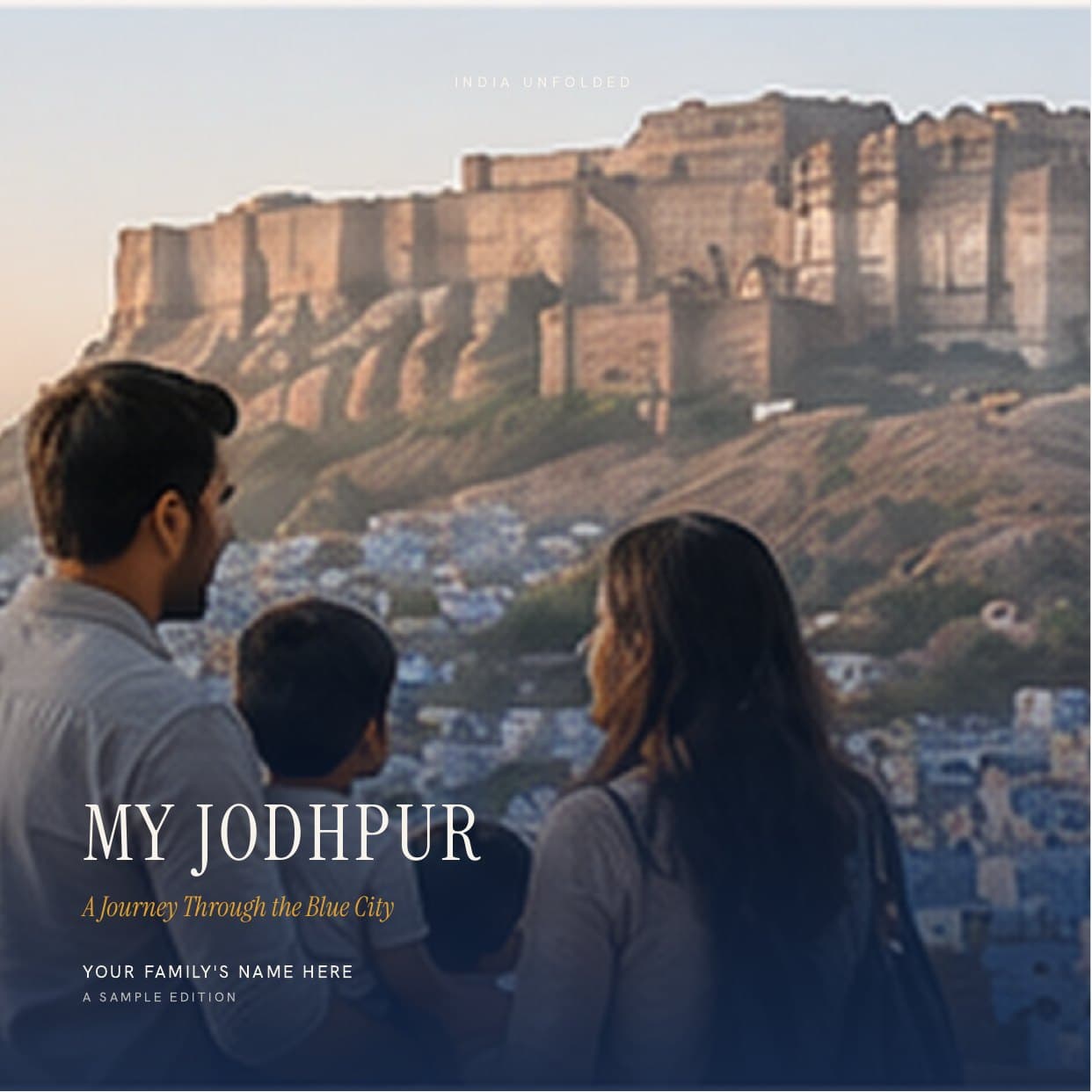
The fort above the city
- WHERE
- A terrace facing the fort — your guesthouse roof, golden hour
- FOCUS
- The fort, high in the frame; your family in front, looking at it
- HOW
- Stand back, phone level, everyone looking at the fort — not at you
SHOT 01 OF TWELVE · DO THIS, IN ORDER
- 1Go up to a rooftop that faces the fort an hour before sunset (or just after sunrise) — Indique at Pal Haveli, RAAS's terraces under the walls, or the free viewpoint on the Jaswant Thada road.
- 2Put your family at the terrace edge, half-turned away from you, looking at the fort.
- 3Hold the phone sideways (landscape). Step back three or four paces.
- 4Tilt so the fort sits in the top third, the city in the middle, your family at the bottom edge.
- 5Tap once on the fort so the phone focuses there. Press the shutter when nobody is looking at you.
PLACES THAT WORK
- Indique, the rooftop at Pal Haveli by the clock tower
- RAAS Jodhpur's terraces, directly under the fort's walls
- The Jharokha rooftop at Hotel Haveli, Makrana Mohalla
- The Jaswant Thada approach-road viewpoint — free, no gate, best in the morning
- BEST LIGHT
- Early morning or the last hour of the day
- PHONE
- Landscape · 1× · timer
WHY THIS SHOTEvery Jodhpur story begins with the rock Rao Jodha chose in 1459. So does yours.
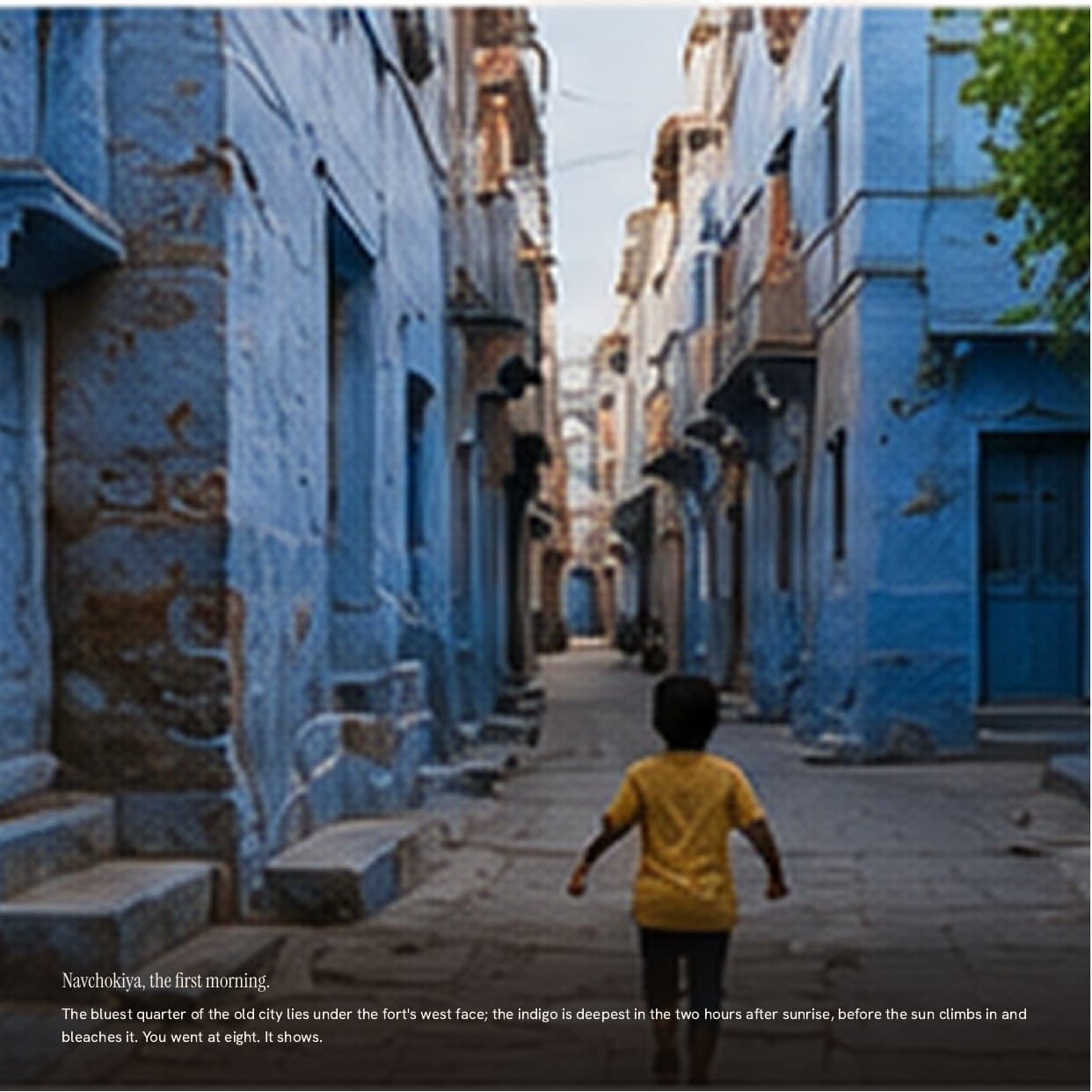
The blue lanes
- WHERE
- Navchokiya's lanes, below the fort's west face, before 9am
- FOCUS
- Blue walls on both sides; one child walking away down the lane
- HOW
- Stand in the middle of the lane, phone upright, and let them walk
SHOT 02 OF TWELVE · DO THIS, IN ORDER
- 1Get to Navchokiya before nine, while the lanes are in shade.
- 2Find a lane that runs straight for twenty metres with blue walls both sides.
- 3Stand in the middle, hold the phone upright (portrait) at chest height, keep it level.
- 4Send one of the children walking ahead — don't call them back.
- 5Tap once on the far wall, then shoot when they're a quarter of the way down.
- BEST LIGHT
- First two hours after sunrise — soft shade, the indigo at its deepest
- PHONE
- Portrait · 1×
WHY THIS SHOTThe colour nobody can fully explain — the city's oldest open question.
Through the gate
- WHERE
- An old-city gate — Chand Pol or a Navchokiya arch, mid-morning
- FOCUS
- The whole arch; your family walking through it into the light
- HOW
- Stand ten paces back in the shade and shoot through the arch
SHOT 03 OF TWELVE · DO THIS, IN ORDER
- 1Mid-morning, stand inside the gate passage, ten paces back from the arch.
- 2Hold the phone upright and centre the arch — get the whole curve in.
- 3Ask your family to walk away from you, through the arch, holding hands.
- 4Tap on the bright street beyond the arch (not on the dark stone).
- 5Shoot when they are just past the arch, still in the frame.
PLACES THAT WORK
- Chand Pol, the old city's western gate below the fort
- Jalori Gate or Sojati Gate, the southern entrances to the walled city
- Any carved haveli arch in the Navchokiya lanes
- BEST LIGHT
- Mid-morning, when the arch is in shade and the street beyond is lit
- PHONE
- Portrait · 1×
WHY THIS SHOTGates are how Jodhpur organises itself — fort, city, home. Passing through one is the story in miniature.
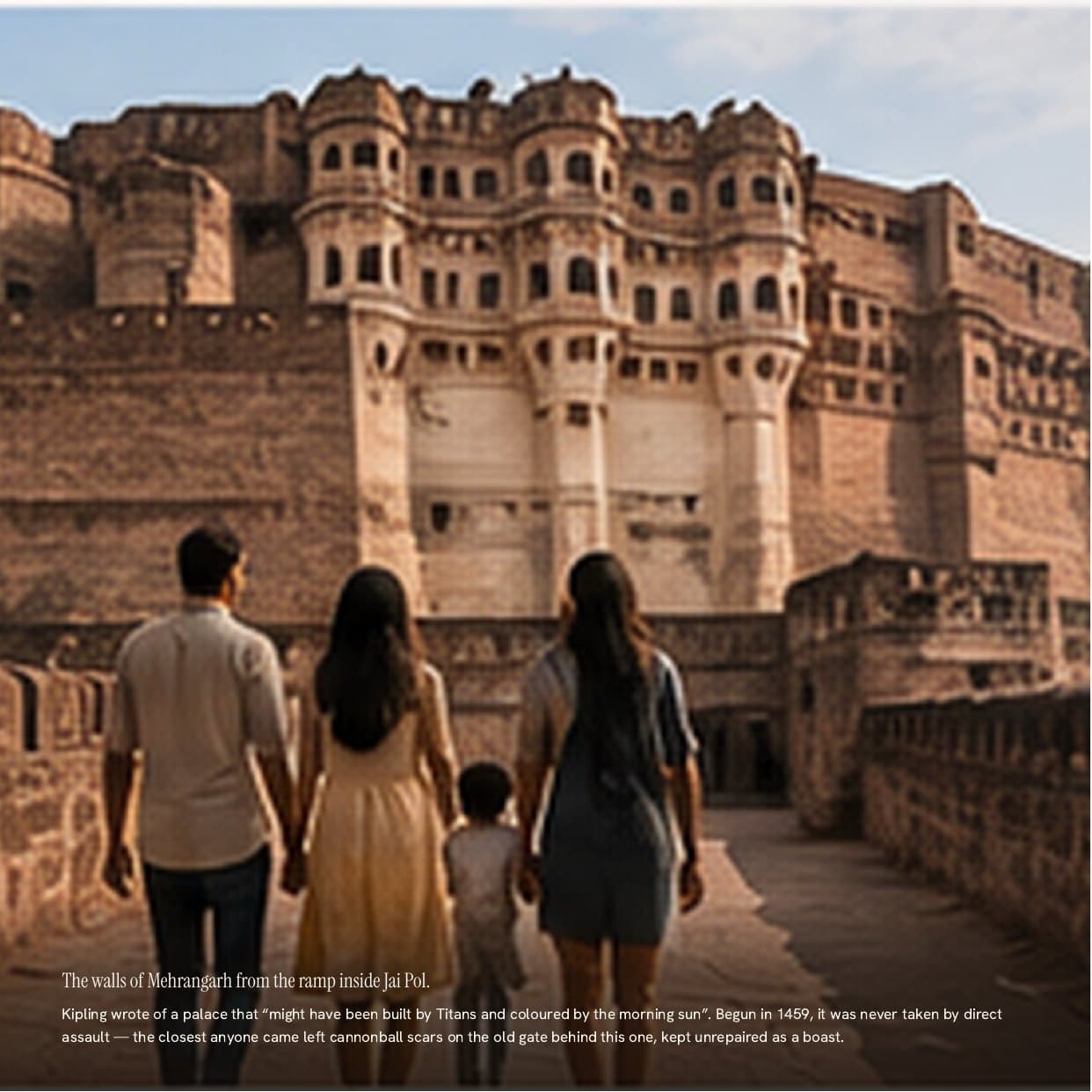
The walls close in
- WHERE
- The ramp inside Jai Pol, Mehrangarh, in the morning
- FOCUS
- The walls, filling two-thirds of the picture; people tiny at the bottom
- HOW
- Tilt the phone up, use the wide lens, keep them small
SHOT 04 OF TWELVE · DO THIS, IN ORDER
- 1Enter the fort at 9:00 and stop on the ramp below the first bend.
- 2Let your family walk on ten paces ahead of you.
- 3Hold the phone sideways and switch to the wide lens (0.5×) if you have one.
- 4Tilt up until the walls fill most of the frame and the family is at the very bottom.
- 5Tap on the wall, then shoot. The smaller they look, the better the picture.
- BEST LIGHT
- Morning — the walls face the sun and glow
- PHONE
- Landscape · 0.5×
WHY THIS SHOTKipling's palace 'built by Titans' — the scale only makes sense from beneath it.
The carved courts
- WHERE
- Mehrangarh's palace courtyards, any open hour
- FOCUS
- Carved stone from edge to edge; one person beneath it, looking up
- HOW
- Stand under an arch, phone upright, tap on the carving
SHOT 05 OF TWELVE · DO THIS, IN ORDER
- 1Inside the palace, stop at the edge of a courtyard with carved screens on the far wall.
- 2Stand under an arch so its edge is on one side of your picture.
- 3Put one person beneath the carving and ask them to look up at it.
- 4Hold the phone upright and straight — vertical lines should stay vertical.
- 5Tap on the carving (never the sky), then shoot.
- BEST LIGHT
- Any hour — the courtyards are in open shade
- PHONE
- Portrait · 1×
WHY THIS SHOTWhole walls are lattice here, so the court could watch without being seen. Look closer, and you'll see the story the plaques leave out.
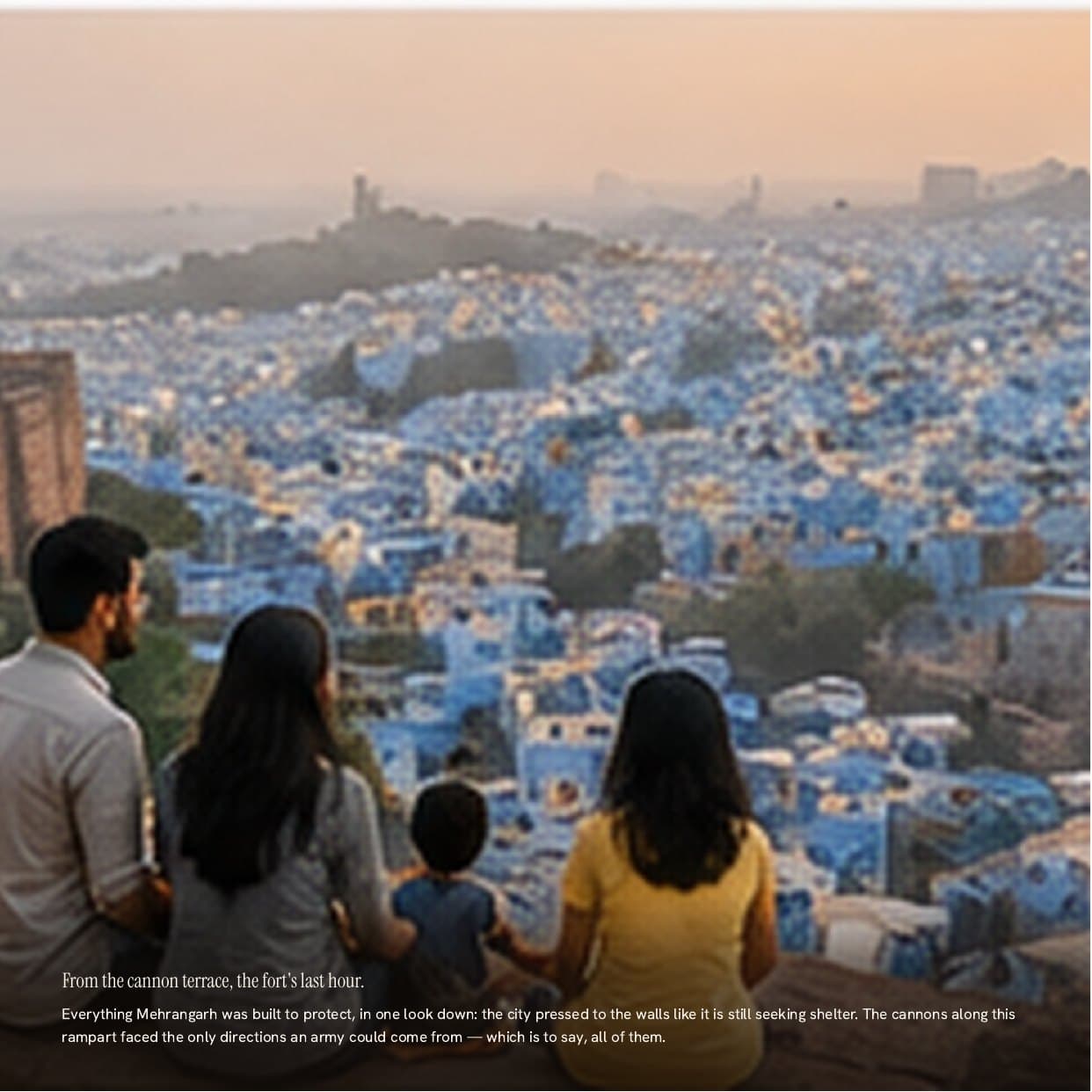
The city from the ramparts
- WHERE
- Mehrangarh's cannon terrace, the fort's last hour (closes 17:00)
- FOCUS
- Your family at the wall, backs to you; the blue city below; a third of sky
- HOW
- Brace your elbows on the parapet, phone sideways, shoot over their shoulders
SHOT 06 OF TWELVE · DO THIS, IN ORDER
- 1Take the rampart walk to the long cannon terrace by 16:00.
- 2Sit your family on or at the wall, backs to you, looking out.
- 3Hold the phone sideways and rest your elbows on the parapet.
- 4Frame it in three layers: wall and family at the bottom, blue city in the middle, sky on top.
- 5Tap on the city, then shoot. Take two — one with everyone still, one with someone pointing.
- BEST LIGHT
- The fort's last hour — it closes at 17:00
- PHONE
- Landscape · 1×
WHY THIS SHOTThe whole relationship in one frame: the fortress, and the city that painted itself blue beneath it.
The marble glow
- WHERE
- Jaswant Thada's approach path, at midday
- FOCUS
- The white dome dead centre; your family walking toward it
- HOW
- Stand on the path's centre line, phone upright, slide the brightness down a touch
SHOT 07 OF TWELVE · DO THIS, IN ORDER
- 1Go at midday — the one place in Jodhpur that wants the high sun.
- 2Stand on the centre of the approach path, far enough back that the whole building fits.
- 3Hold the phone upright and put the dome exactly in the middle.
- 4Send the family walking toward it, backs to you.
- 5Tap on the marble, then slide your finger down a little to darken it — that keeps the white from burning out. Shoot.
- BEST LIGHT
- High sun, midday — the only shot here that wants it
- PHONE
- Portrait · 1×
WHY THIS SHOTGrief turned luminous: a memorial built in 1899 from stone that glows from within.
The stepwell
- WHERE
- Toorji Ka Jhalra's top step, the first hour after sunrise
- FOCUS
- The steps stacking down to the water; your family at the top edge
- HOW
- Stand centred on the short side, one pace back, and shoot slightly downward
SHOT 08 OF TWELVE · DO THIS, IN ORDER
- 1Be there at sunrise, before the cafés open — it will be nearly empty.
- 2Stand at the top step of the well's short side, one full pace back from the edge (no rail).
- 3Hold the phone upright and level, and point it slightly down the steps.
- 4Put your family at the top edge to one side, looking down into the well.
- 5Tap on the steps, then shoot. Keep it symmetrical — if the steps lean, straighten the phone.
- BEST LIGHT
- First hour after sunrise — soft, even, and mirror-still water
- PHONE
- Portrait · 1× or 0.5×
WHY THIS SHOTDesert engineering as geometry — an 18th-century queen's gift to a thirsty city.
The heart of the city
- WHERE
- Sardar Market, at dusk as the lights come on
- FOCUS
- The clock tower sharp in the centre; the crowd blurred around it
- HOW
- Lean the phone against a pillar, night mode on, hold still
SHOT 09 OF TWELVE · DO THIS, IN ORDER
- 1Arrive at the market about ten minutes before sunset and find a spot facing the tower.
- 2Hold the phone sideways and lean it or your shoulder against a pillar or wall.
- 3Put the tower in the centre; let your family stand at one edge looking at it.
- 4Turn night mode on if your phone offers it.
- 5Hold completely still and shoot. The blur of the crowd is the picture — the tower stays sharp.
- BEST LIGHT
- Dusk — the lights coming on
- PHONE
- Landscape · night mode
WHY THIS SHOTSardar Market is where Jodhpur stops performing and simply gets on with being itself.
The light changes
- WHERE
- A west-facing rooftop, the last hour before sunset
- FOCUS
- The low sun, the rooftops to the horizon, your family in silhouette
- HOW
- Tap on the sky — not on the people — so the colour stays
SHOT 10 OF TWELVE · DO THIS, IN ORDER
- 1Be on a west-facing rooftop a full hour before sunset — Pachetia Hill (free), Singhvi's Haveli in Navchokiya, or the Stepwell House terrace.
- 2Stand your family at the parapet, slightly to one side, watching the sun.
- 3Hold the phone sideways. Don't zoom.
- 4Tap once on the sky, not on the people — they should go dark, the sky should stay rich.
- 5Shoot every few minutes as the colour changes. The best frame is often ten minutes after the sun goes.
PLACES THAT WORK
- Pachetia Hill — the free viewpoint above Sodagaran Mohalla, reached on foot up through the Navchokiya lanes
- Singhvi's Haveli rooftop, Navchokiya — the blue quarter below you
- The terrace at Stepwell House above Toorji Ka Jhalra
- Rao Jodha Desert Rock Park, from the trail below the fort's west walls
- BEST LIGHT
- The last hour before sunset
- PHONE
- Landscape · 1×
WHY THIS SHOTThe one hour the city changes colour — the photograph everyone wants and almost nobody plans for.
The lanes at dusk
- WHERE
- The old-city lanes, twenty minutes after sunset
- FOCUS
- Your family walking away from you, hand in hand, down a narrowing lane
- HOW
- Follow five paces behind, night mode on, shoot mid-step
SHOT 11 OF TWELVE · DO THIS, IN ORDER
- 1Walk back through the lanes in the half hour after sunset — Navchokiya, or the lanes between Sardar Market and the stepwell — while the sky still has colour.
- 2Let your family walk five paces ahead of you, holding hands.
- 3Hold the phone upright, night mode on, elbows tucked in.
- 4Stop where the lane narrows or bends ahead of them.
- 5Don't call them — shoot when they are mid-step and not looking back.
PLACES THAT WORK
- The lanes of Navchokiya, below the fort's west face
- Tambaku Bazaar and the lanes between Sardar Market and Toorji Ka Jhalra
- Makrana Mohalla, the guesthouse quarter under the fort
- BEST LIGHT
- Twenty minutes after sunset — blue hour, the lamps just on
- PHONE
- Portrait · night mode
WHY THIS SHOTThe human moment — the one photograph that will mean most in ten years.
The fort, floodlit
- WHERE
- A fort-view rooftop, 15–60 minutes after sunset
- FOCUS
- The floodlit fort above; the edge of your table below
- HOW
- Rest the phone on the table edge, night mode on
SHOT 12 OF TWELVE · DO THIS, IN ORDER
- 1Book a rooftop with a fort view for your last dinner — Indique at Pal Haveli, or Darikhana at RAAS under the walls — and ask for a fort-facing table. You will need to be a guest or eat there.
- 2Wait until the floodlights are on but the sky is still blue — within an hour of sunset.
- 3Wipe the lens. Turn night mode on.
- 4Rest the phone on the table edge or against a glass so it doesn't shake.
- 5Get a glass or a candle soft in the bottom of the frame, the lit fort above, and shoot.
PLACES THAT WORK
- Indique at Pal Haveli — the classic angle over the clock tower to the fort
- Darikhana or the Baradari at RAAS, with the floodlit walls directly above
- The Jharokha rooftop at Hotel Haveli
- BEST LIGHT
- Fifteen to sixty minutes after sunset
- PHONE
- Landscape · night mode, braced
WHY THIS SHOTThe closing image: you leave tomorrow; Mehrangarh has been lit like this for visitors since long before you came, and will be long after.
All twelve, with the standing position, the light window and the steps for each, are inside The Jodhpur Guide and on the Jodhpur Shot List. These aren’t photography tips. These twelve photographs become your book.
COMING NEXTGuide My Shot — a creative director in your hand. Stand where it says and it finds the light, the position and the frame for you, for anyone who wants the thinking taken out of the picture. You can do it without it, if you’re good at following instructions.
Create my book
Your journey,
already told.
You take the photographs. India Unfolded already knows the story.
12 directed moments
+ your own memories
+ our maps and storytelling
= your personal India book.
A 32-page sample edition, made from the twelve example photographs above.
Watch Out For
TOURIST TRAP
“The fort is closed today”
It isn't. Anyone at the gates offering an alternative tour, a “special viewpoint” or their cousin's shop is working a script. Walk on; tickets are sold inside.
TOURIST TRAP
The commission detour
Auto drivers who insist your guesthouse “burned down” or push a textile emporium earn 30–50% of what you spend there. Agree the route before you get in.
GOOD TO KNOW
The old city is a maze
Lanes are unnamed and GPS gets confused inside the walls. Screenshot your guesthouse's landmark directions — and treat getting lost as part of the visit.
What It Costs
Entry fees below were read off Mehrangarh Museum Trust and Rajasthan Tourism on 24 August 2026. They change without notice — check before you go. Street prices for food, lassi and autos move week to week, so we give typical ranges, not quotes. Spot a change? Tell us and we fix it in days.
$1 ≈ ₹95 (FBIL reference rate, verified 23 August 2026)
| Mehrangarh Fort — foreign visitors, audio guide included | ≈ ₹800 |
| Mehrangarh — international students, with a card | ≈ ₹500 |
| Mehrangarh — the elevator, one way | ≈ ₹50 |
| Jaswant Thada — foreign visitors | ≈ ₹100 |
| Rao Jodha Desert Rock Park | ≈ ₹100 |
| Auto-rickshaw across the old city | ₹100 – 150 |
| Thali dinner at a local restaurant | ₹150 – 300 |
| Makhania lassi at the clock tower | ≈ ₹40 |
| Bishnoi village half-day jeep safari | ₹1,200 – 1,800 |
What to Bring Home
Getting Around
Still deciding?
We take a side, and say why
Plan Jodhpur
The questions everyone asks, answered properly
And because you read this far
The Jodhpur Food Guide — our gift, no catch.
Seven dishes of the Blue City with their stories, spices and honest home recipes — makhania lassi to laal maas. Free to download, made to be cooked the week you get home.
The full guide
Everything above is the appetizer.
The 32-page Jodhpur guide adds the full story of Marwar with a dated timeline, checklist itineraries built to be ticked, the Blue Lanes walk, where locals actually eat, named stays, and the 12-frame Shot List — designed to read, print and carry.