India Unfolded is the creative director. You are the photographer. These aren’t photo spots — the twelve follow a narrative arc, so that together, in order, they tell the whole of Jodhpur in one album.
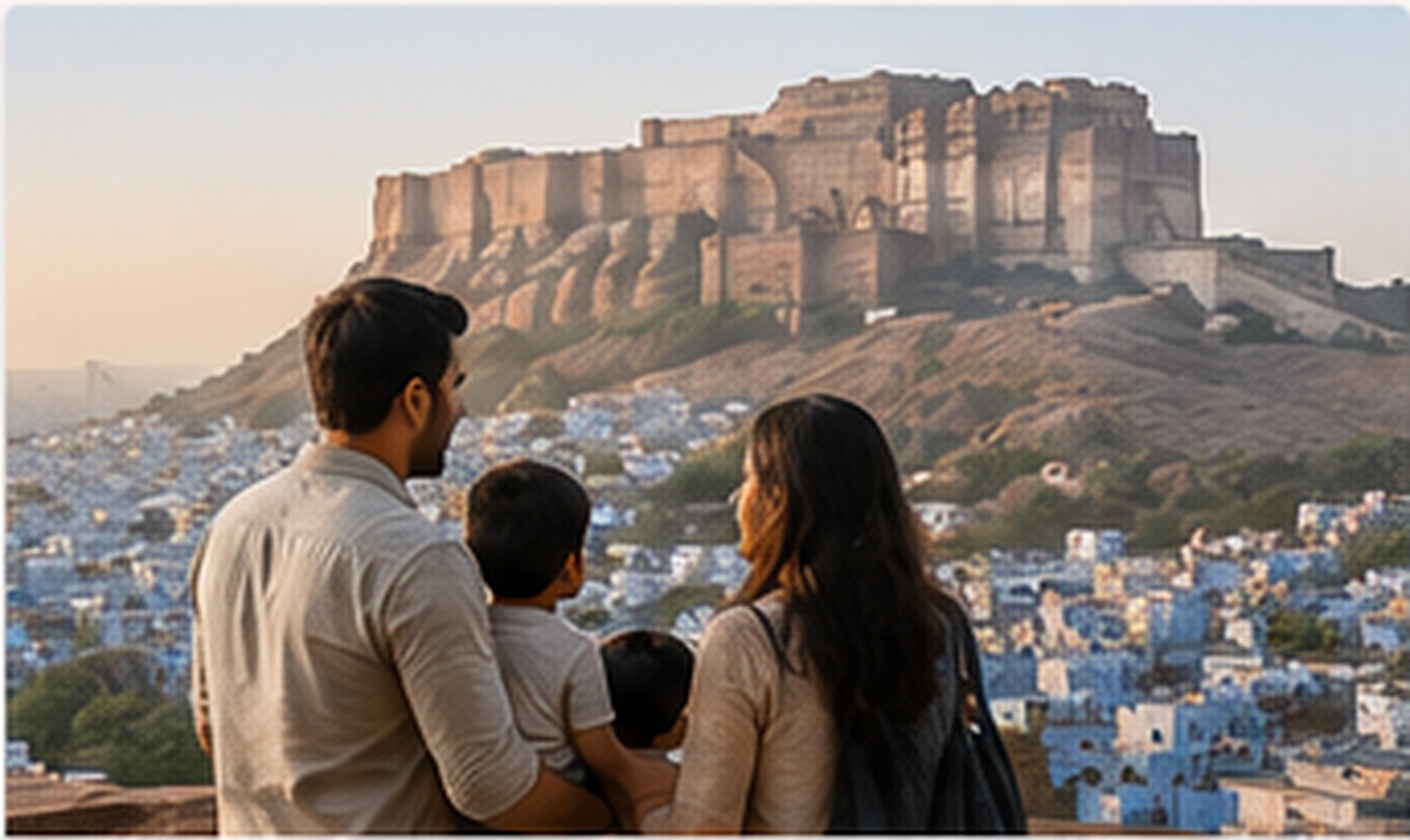
The first look: the rock, the fort, the city pressed to its feet. — our own frame, shot to this direction.
SHOT 01 OF 12 · ARRIVAL
The Fort Above the City
Every Jodhpur story begins with the rock Rao Jodha chose in 1459 — so does yours. The first look: the fort, the city pressed to its feet, and you, looking at it.
The place
A terrace facing the fort — Indique at Pal Haveli, RAAS's terraces under the walls, Jharokha 360 at The Stepwell Hotel, or the free Jaswant Thada approach-road viewpoint
Stand here
Stand at the terrace edge with the fort ahead of you, the family half-turned away from the camera, looking at it. The photographer stands three to four paces back — or prop the phone on the parapet and use the timer.
People
You. That's the point — this is the family's opening frame.
The light
Low light is everything here: the first hour after sunrise or the last before sunset turns the sandstone amber and keeps the sky soft. Midday flattens the rock to grey.
GOLDEN HOUR — THE LAST HOUR BEFORE SUNSET, OR THE FIRST AFTER SUNRISE Oct–Nov ≈ 4:50pm – 5:40pm · Dec–Jan ≈ 4:45pm – 5:35pm · Feb–Mar ≈ 5:25pm – 6:15pm
From the old city (west of the fort) the evening light is best; from the Jaswant Thada road (east) the morning light hits the walls first.
The frame
Fort high in the frame, city below, your family off-centre in the foreground looking at it — NOT at the camera. The picture is about attention, not faces.
Landscape orientation, main lens (1×). Timer at 3 seconds beats a stranger's rushed tap.
Did our direction work?CURATED · NOT YET FIELD-CHECKED
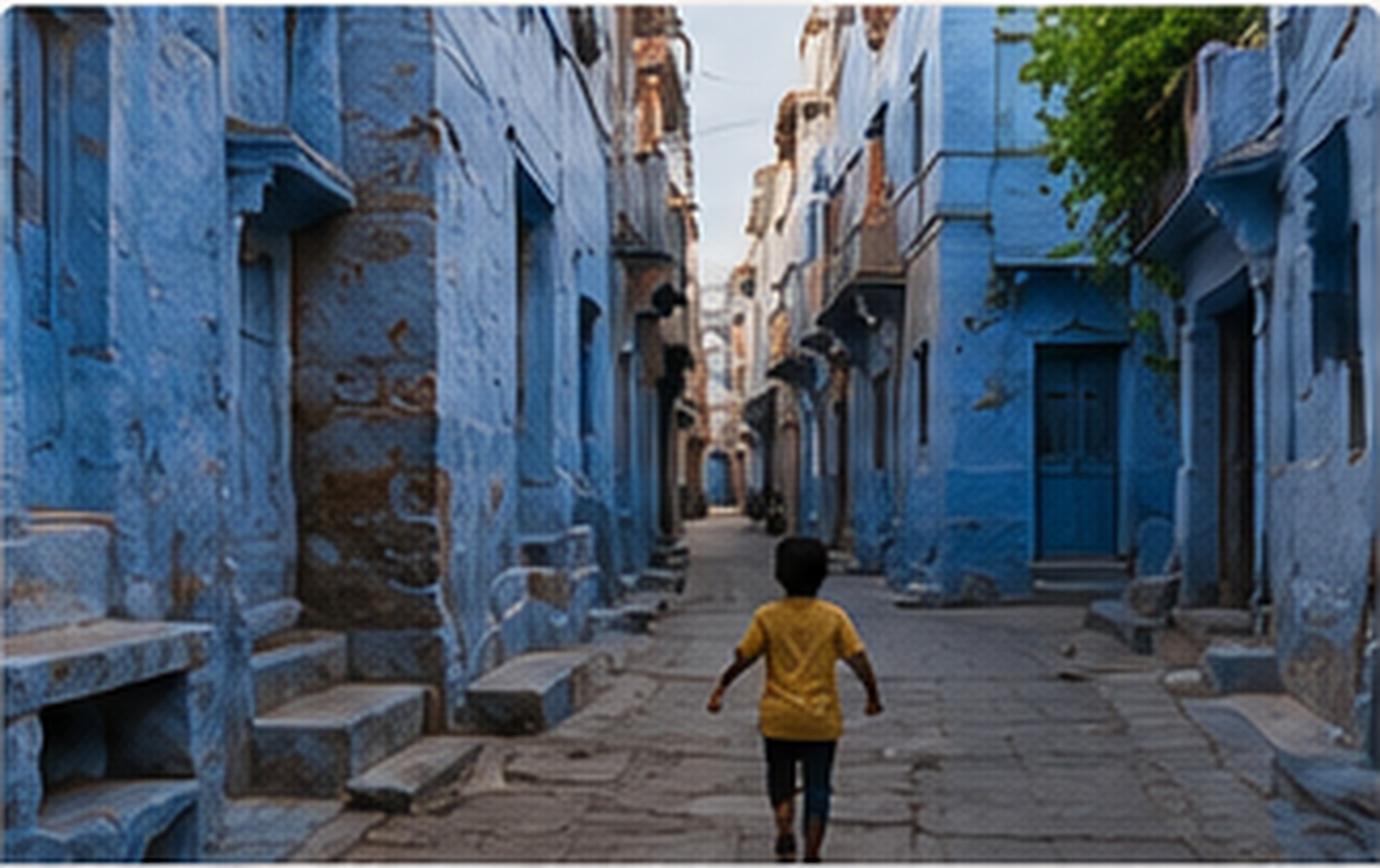
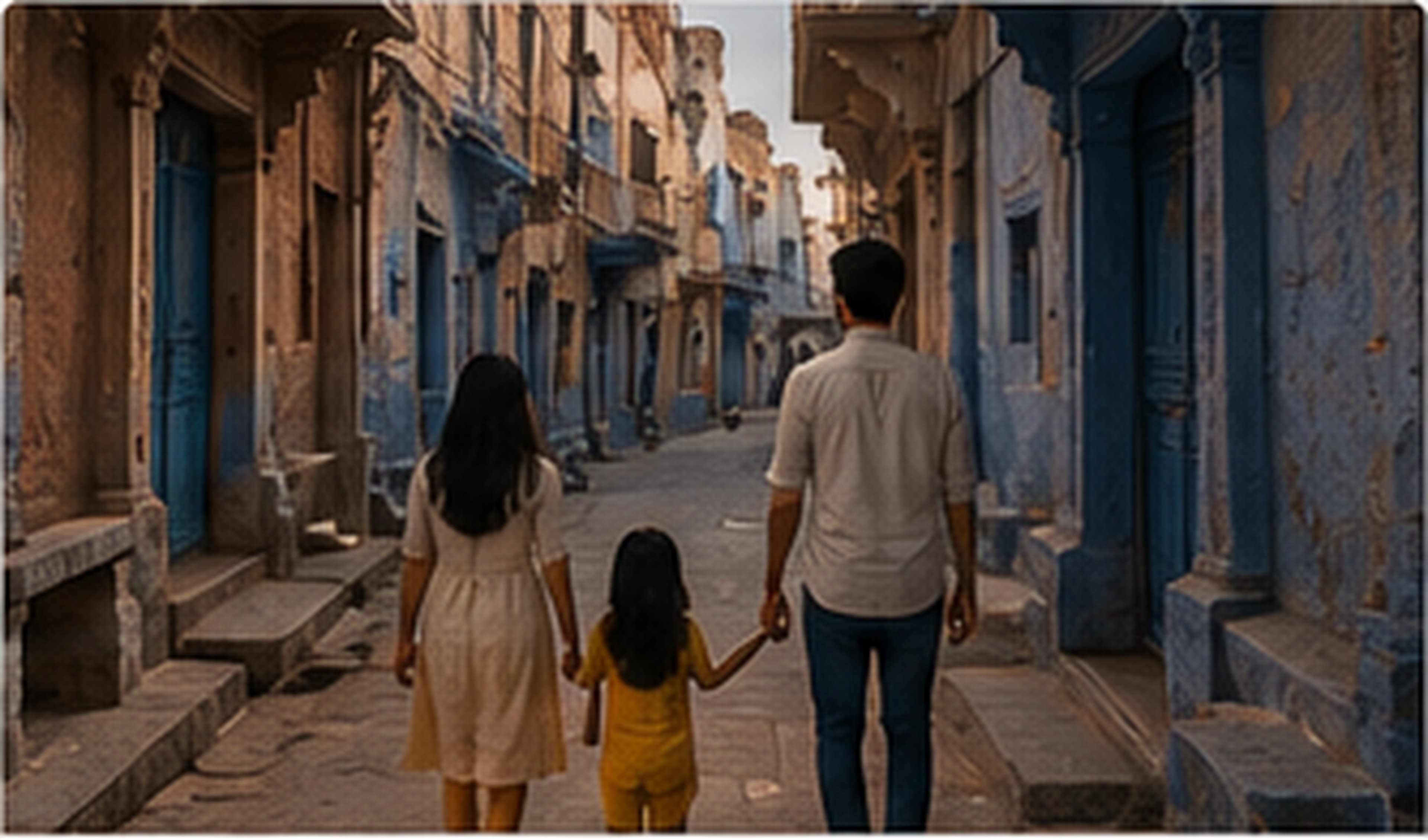
Navchokiya, before the lanes wake. — our own frame, shot to this direction.
SHOT 02 OF 12 · THE BLUE CITY
The Blue Lanes
The first thing Jodhpur announces about itself, and the last mystery it keeps: nobody can fully prove why the city is blue. Your story starts inside the colour.
The place
Navchokiya — the lanes west of the fort's base, the bluest quarter of the old city
Stand here
Walk in from Navchokiya Road and stop wherever a lane runs straight for twenty metres with indigo walls on both sides. Stand in the middle of the lane, camera at chest height.
People
One of you, small, walking away down the lane — a child running ahead is the frame.
The light
Early sun stays low behind the houses, so the lanes sit in soft, even shade — exactly what indigo wants. By mid-morning direct sun hits the walls and bleaches the blue flat.
THE FIRST TWO HOURS AFTER SUNRISE Oct–Nov ≈ 7:00am – 8:10am · Dec–Jan ≈ 7:40am – 8:50am · Feb–Mar ≈ 7:20am – 8:30am
The frame
Let the walls fill both edges of the frame and the lane pull the eye to a bend or doorway. If a resident, a bicycle or a dog crosses, wait one beat and shoot — life beats emptiness.
Portrait orientation, main lens (1×). Keep the phone level so the walls don't lean.
Did our direction work?CURATED · NOT YET FIELD-CHECKED
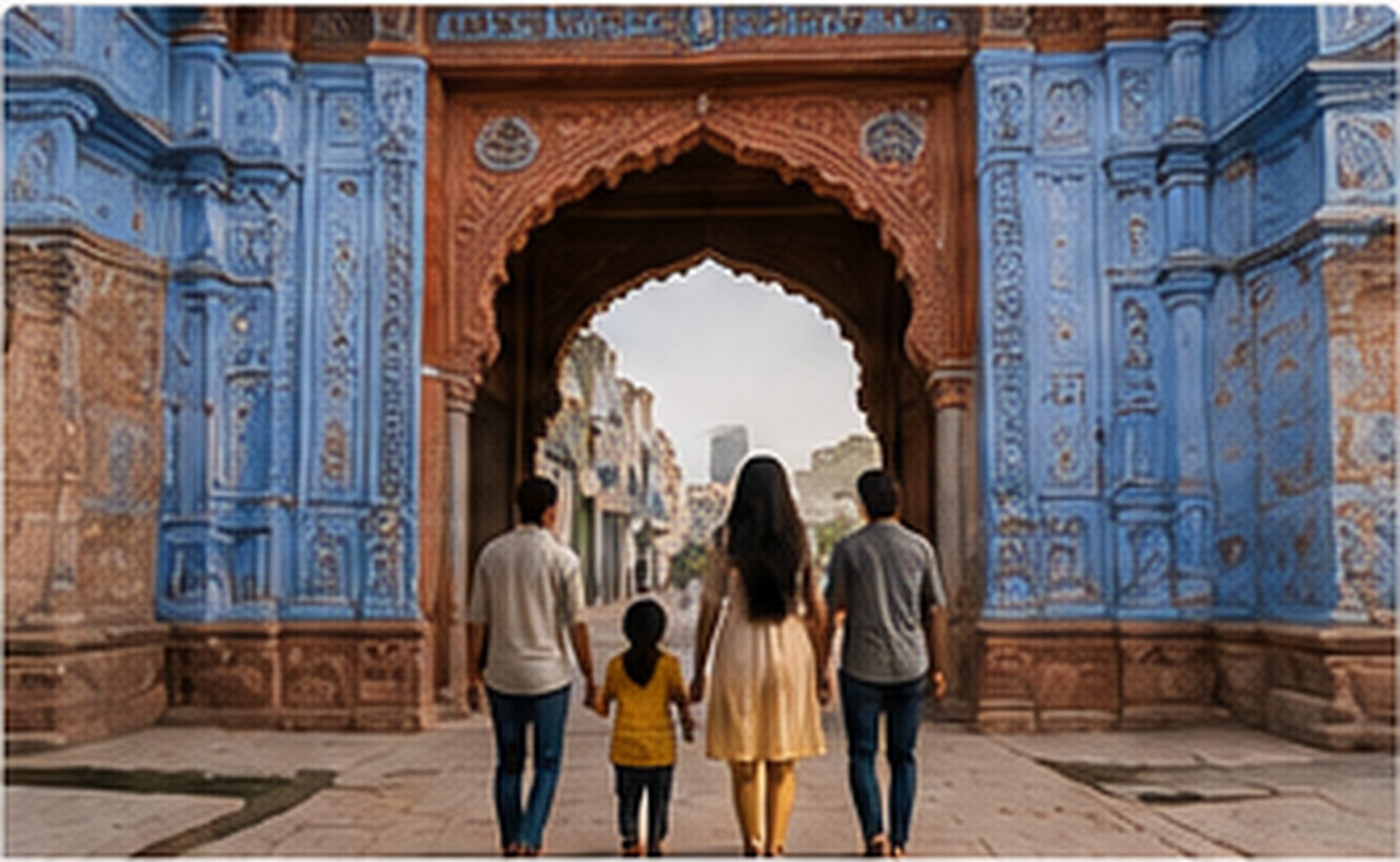
A threshold, and the city on the other side. — our own frame, shot to this direction.
SHOT 03 OF 12 · THE GATEWAY
Through the Gate
Jodhpur organises itself by gates — fort, city, home. Walking through one is the whole story in miniature: a threshold, and the city on the other side.
The place
One of the old city's gates — Chand Pol, or Jalori or Sojati Gate, or any carved haveli arch in Navchokiya where you can stand back with the street lit beyond
Stand here
Stand centred on the arch, ten paces back, inside the shade of the gate passage. Your family walks away from you, through the arch, into the light. Don't call them.
People
Yours — backs to the camera, mid-stride, hand in hand.
The light
Mid-morning is right: the arch sits in shade while the street beyond is in full sun, so the gate becomes a dark frame around a bright picture.
MID-MORNING — THE ARCH IN SHADE, THE STREET BEYOND IN SUN Oct–Nov ≈ 8:20am – 9:30am · Dec–Jan ≈ 9:00am – 10:10am · Feb–Mar ≈ 8:40am – 9:50am
The frame
The arch is a frame inside your frame: keep its whole curve in the picture, the far street bright in the middle, people small and walking away. Tap on the bright street so the phone exposes for it.
Portrait orientation, main lens (1×). Hold the phone level — a tilted arch looks like a mistake.
Did our direction work?CURATED · NOT YET FIELD-CHECKED
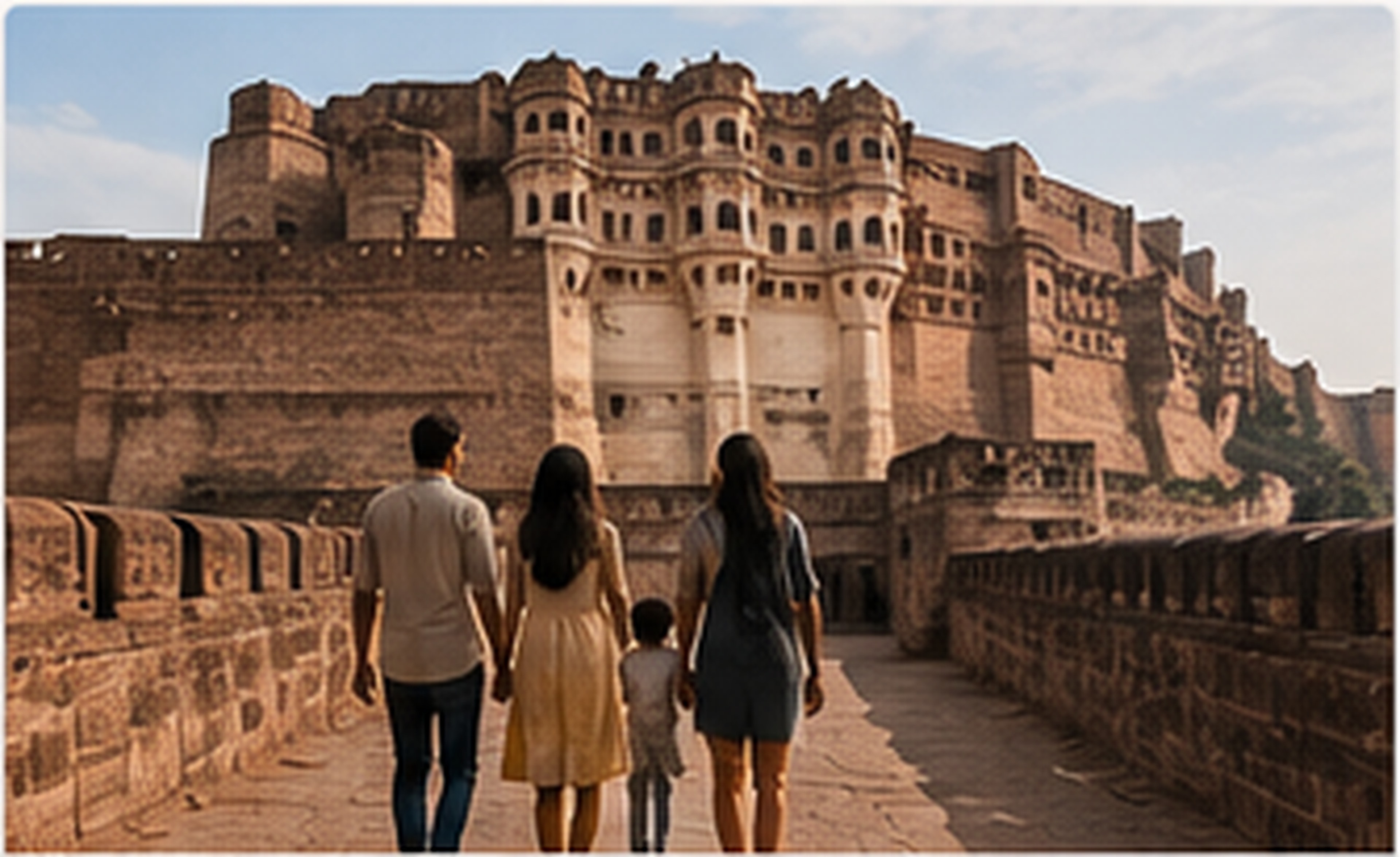
The ramp to the gates; the walls growing straight out of the rock. — our own frame, shot to this direction.
SHOT 04 OF 12 · THE FORT APPROACH
The Walls Close In
Kipling's palace 'built by Titans' — and the scale only makes sense from beneath it, on the ramp, with a hundred and twenty metres of rock and rampart rising over you.
The place
The ramp inside Jai Pol, climbing toward the inner gates — the first two hundred metres past the ticket gate
Stand here
On the ramp below the first bend, with the walls rising on your right. Stand against the outer parapet, let your family walk on ahead, and look up.
People
Yours, small, walking uphill ahead of you — backs to the camera.
The light
Morning: the east-facing walls are in full sun and glow gold against a blue sky. By afternoon they fall into shadow and go flat.
MORNING, ONCE THE FORT OPENS AT 9:00 Oct–Nov ≈ 9:40am – 11:00am · Dec–Jan ≈ 10:20am – 11:40am · Feb–Mar ≈ 10:00am – 11:20am
Fort open 9:00–17:00; the ramp is steep — give yourselves time, and shoot before the day's heat.
The frame
Tilt the phone up until the walls fill two-thirds of the frame; put your family at the bottom edge, small, walking up. Scale is the picture — the smaller they are, the bigger the fort.
Landscape orientation, wide lens (0.5×) if you have it; otherwise main lens (1×) and take three steps back.
Did our direction work?CURATED · NOT YET FIELD-CHECKED
Screens a court once watched the city through. — our own frame, shot to this direction.
SHOT 05 OF 12 · INSIDE MEHRANGARH
The Carved Courts
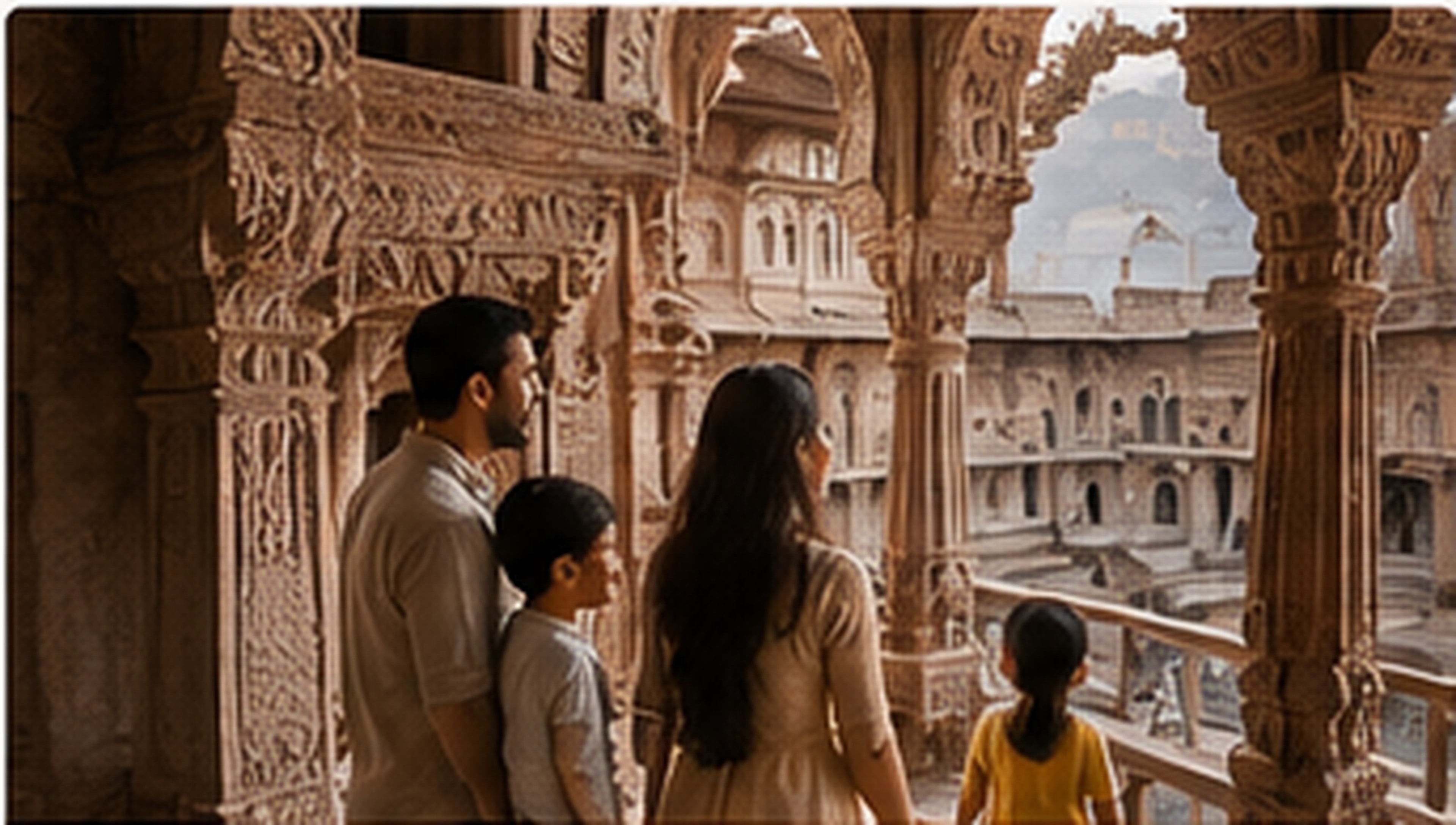
Whole walls here are carved stone screens — the court watched the city through them without ever being seen. The idea of Mehrangarh in one architectural detail.
The place
The palace courtyards of Mehrangarh — Shringar Chowk and the screened walls around it, on the museum route
Stand here
Under an arch at the courtyard's edge, looking across at the carved screens. Stand so a column or the arch edge is at one side of your frame, and your family is beneath the carving.
People
One or two of you, looking up at the carving — not at the camera.
The light
Any open hour — the courtyards sit in open shade, which is exactly what carved stone wants. Direct sun on the screens makes harsh stripes; shade shows every line.
ANY TIME THE FORT IS OPEN — THE COURTS ARE IN OPEN SHADE Oct–Nov ≈ 9:10am – 12:10pm · Dec–Jan ≈ 9:50am – 12:50pm · Feb–Mar ≈ 9:30am – 12:30pm
Fort open 9:00–17:00; the audio guide is included in the foreign ticket and is among the best in India.
The frame
Carved stone from edge to edge, one person beneath it for scale — a child looking up is perfect. Tap on the carving so the phone focuses and exposes for the stone, not the sky.
Portrait orientation, main lens (1×). Hold the phone straight — keep the vertical lines vertical.
Did our direction work?CURATED · NOT YET FIELD-CHECKED
Everything the fort was built to protect, in one look down. — our own frame, shot to this direction.
SHOT 06 OF 12 · THE VIEW
The City from the Ramparts
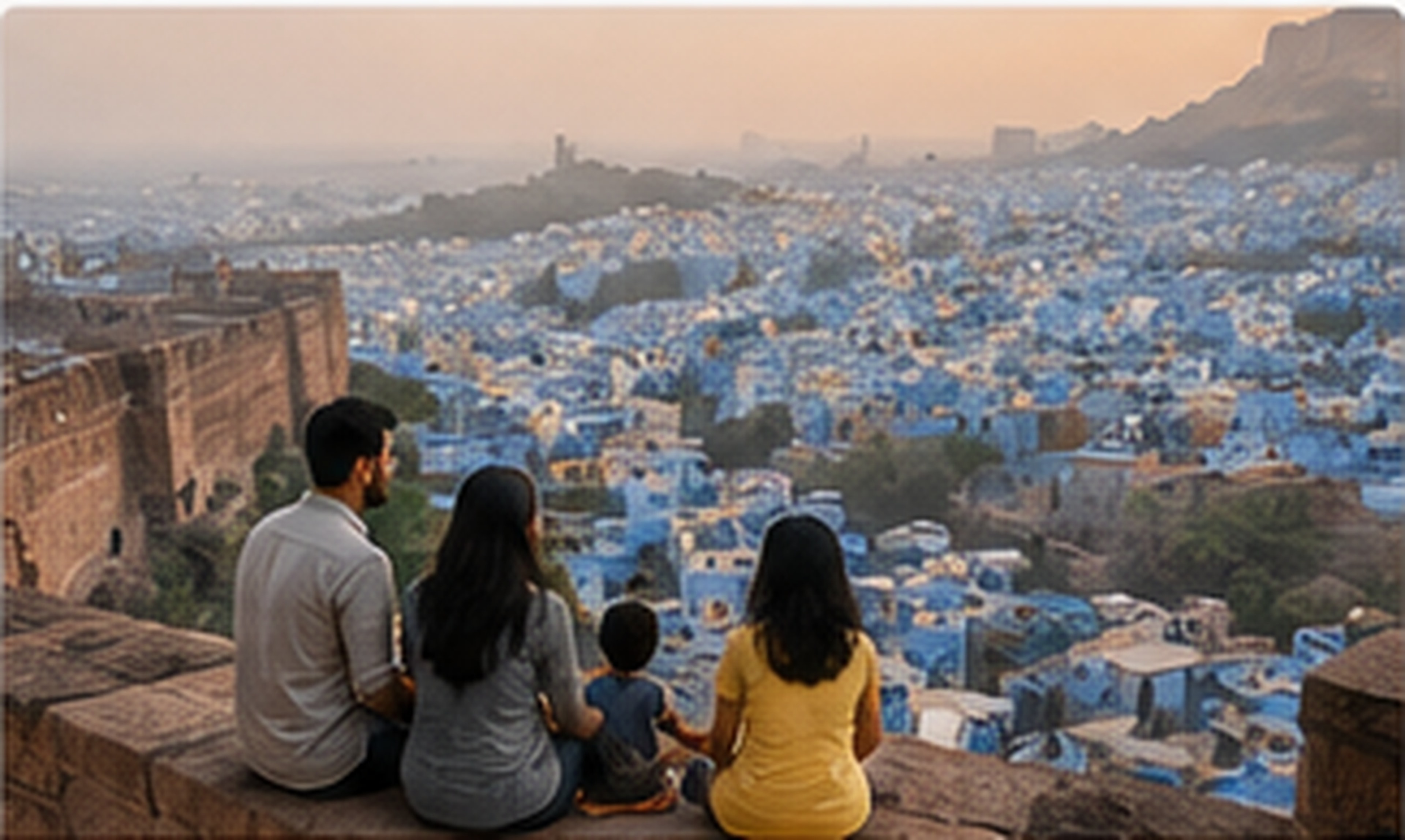
The whole relationship in one look down: the fortress and the city that grew beneath it, painted blue and pressed to the walls like it's still seeking protection.
The place
Mehrangarh Fort — the cannon terrace along the southern ramparts, past the palace museum exit
Stand here
From the museum exit, follow the rampart walk to the long cannon terrace. Stand between the cannons, facing out — the blue quarter spreads below and to your right.
People
Yours — seated on the parapet, backs to the camera, looking out. The family's establishing frame.
The light
The afternoon sun moves west, over the blue city — low light toward you: hazy, layered, atmospheric. The deepest, most saturated blue is the morning version of this view; the late hour trades saturation for depth.
THE LAST AFTERNOON HOUR — AS LATE AS THE FORT ALLOWS Oct–Nov ≈ 4:20pm – 5:00pm · Dec–Jan ≈ 4:15pm – 5:00pm · Feb–Mar ≈ 4:45pm – 5:00pm
Sunset always falls after the fort's 17:00 close. The last hour (16:00–17:00) gives you warm side-light, not golden hour — deepest in Dec–Jan, flattest in Feb–Mar. For the real thing, shoot the same view from the Jaswant Thada approach road, which has no gate.
The frame
Put the rampart wall or a cannon in the lower frame as an anchor, then let the blue city spill to the horizon. Keep a third of frame for sky — the haze glow is part of the picture.
Landscape orientation, main lens (1×) for the classic; wide (0.5×) if you want the wall's sweep. Brace elbows on the parapet.
Did our direction work?CURATED · NOT YET FIELD-CHECKED
Marble carved so thin the sun comes through it. — our own frame, shot to this direction.
SHOT 07 OF 12 · JASWANT THADA
The Marble Glow
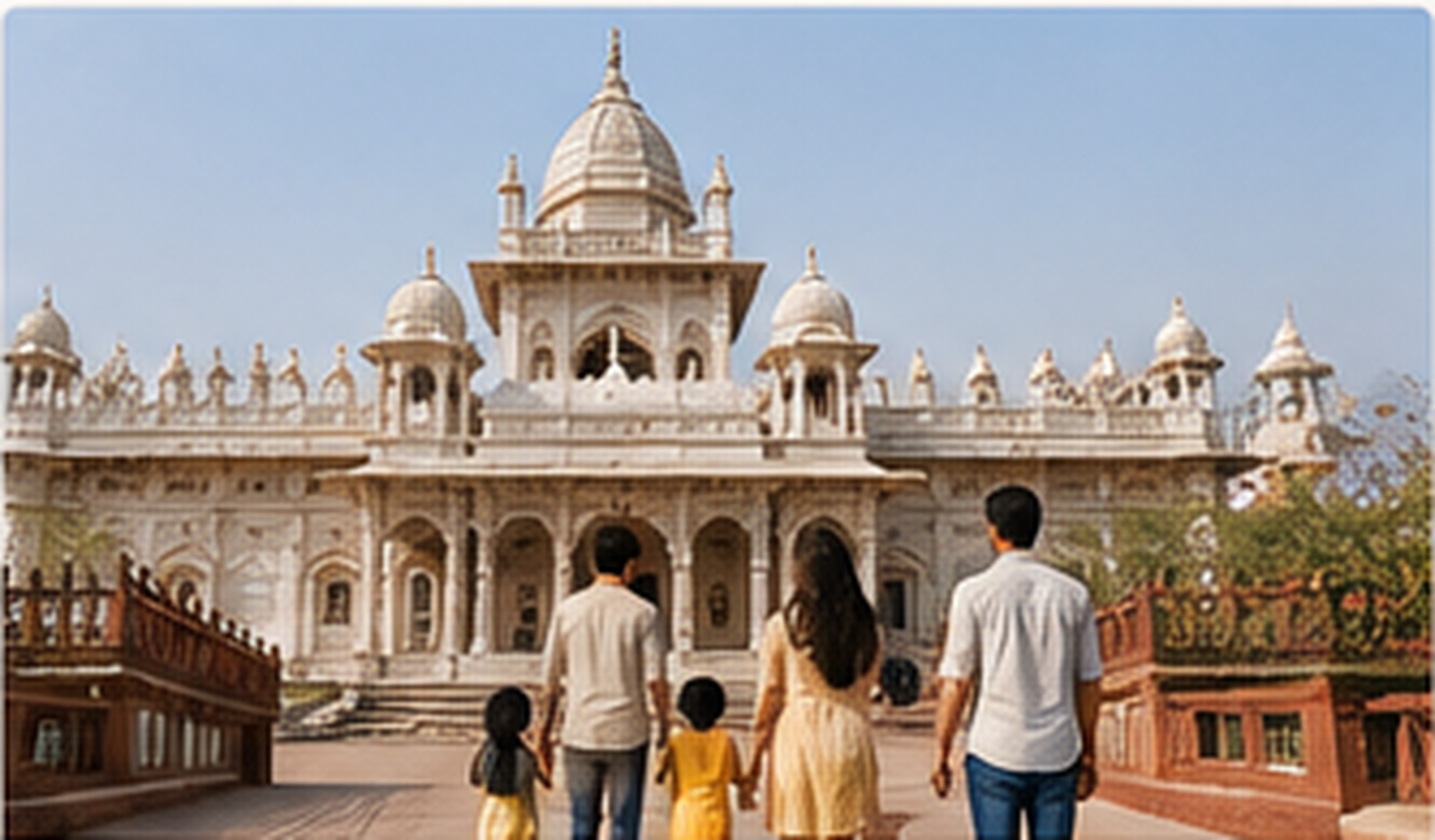
Grief made luminous: Jaswant Thada's marble is carved so thin the walls glow from inside when the sun stands high. Most tour groups skip it. You won't.
The place
Jaswant Thada — the white cenotaph ten minutes' walk from Mehrangarh's ticket gate
Stand here
On the approach path from the gate, the cenotaph centred ahead — far enough back that the whole dome and its side pavilions fit. Then go inside for the glow.
People
Yours, walking toward it, small — backs to the camera.
The light
This is the one shot that WANTS high sun: at midday the white marble is at its brightest, and inside, the thin-sawn panels glow amber-white from within. Morning and evening the stone is beautiful but opaque.
THE HIGH-SUN MIDDLE OF THE DAY Oct–Nov ≈ 12:20pm – 1:50pm · Dec–Jan ≈ 1:00pm – 2:30pm · Feb–Mar ≈ 12:40pm – 2:10pm
Open 9:00–17:00; entry ≈ ₹100 for foreign visitors (≈ ₹50 Indian). Shoulders and knees covered, shoes off at the hall.
The frame
Symmetry: dome dead centre, the path running to it, your family walking toward it. Tap the marble and slide the exposure down a touch so the white keeps its detail.
Portrait orientation, main lens (1×). Keep the phone level so the dome stands straight.
Did our direction work?CURATED · NOT YET FIELD-CHECKED
Water was Marwar's real treasure. The geometry tells that story. — our own frame, shot to this direction.
SHOT 08 OF 12 · TOORJI KA JHALRA
The Stepwell
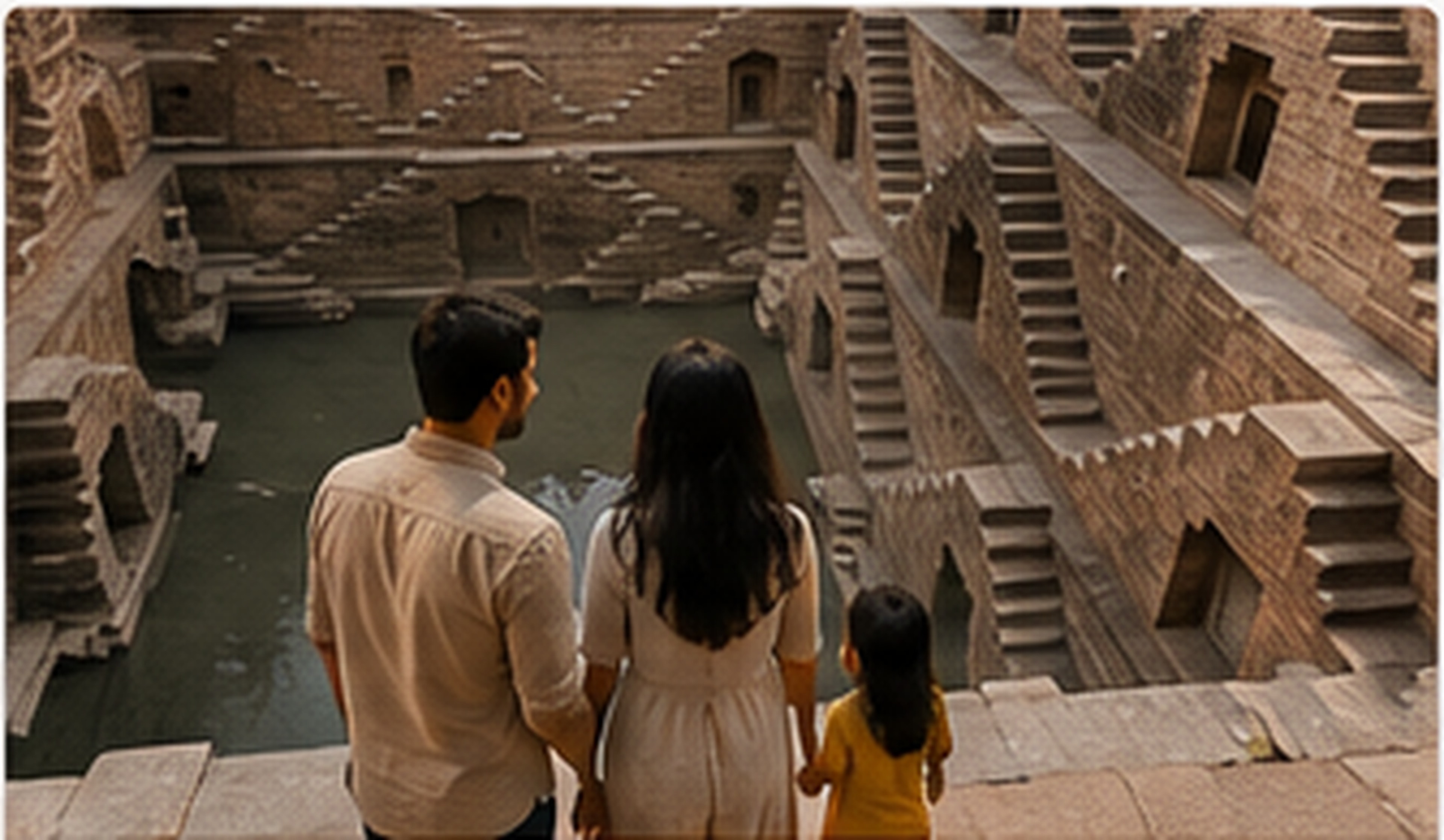
Water was always Marwar's real treasure, and Toorji Ka Jhalra is the proof in geometry — an 18th-century machine for reaching water, beautiful because it had to work.
The place
Toorji Ka Jhalra stepwell, in the Stepwell Square café quarter, ten minutes' walk from the clock tower
Stand here
Stand centred on the top step of the well's short side — a full pace back from the edge; the steps are uneven and there is no rail. Face straight down the axis of the steps.
People
Your family at the top edge, backs to the camera, looking down — they give the geometry its scale.
The light
At dawn the well is in shadow and the light is soft and even — pure geometry, plus mirror-still water. Once the sun climbs in, hard diagonals cut the symmetry (which can work — but it's a different, harsher picture).
SUNRISE TO AN HOUR AFTER — BEFORE THE CAFÉS WAKE Oct–Nov ≈ 6:40am – 7:55am · Dec–Jan ≈ 7:20am – 8:35am · Feb–Mar ≈ 7:00am – 8:15am
The frame
Symmetry is the shot: centre the well's axis, keep the phone level and shoot slightly down so the steps stack into pattern and end at water. No people, or exactly one person small on the steps for scale.
Portrait orientation. Main lens (1×) from the edge, or wide (0.5×) to take in the full descent.
Did our direction work?CURATED · NOT YET FIELD-CHECKED
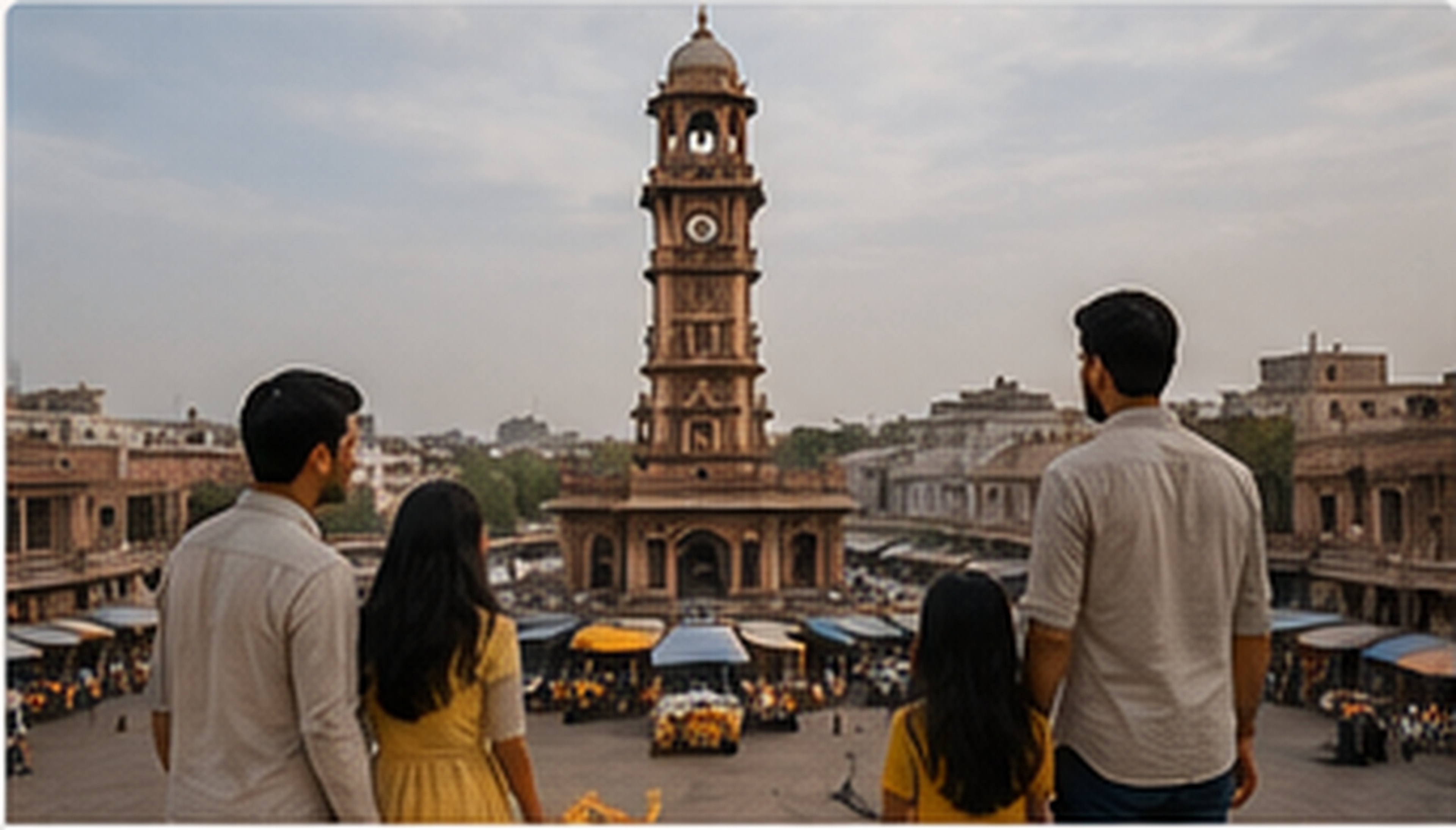
Some monuments tell you who ruled a city. Markets tell you how it lives. — our own frame, shot to this direction.
SHOT 09 OF 12 · THE CLOCK TOWER
The Clock Tower
Every Jodhpur life crosses Sardar Market eventually — the clock tower has been the city's meeting point for a century. This is the shot of the city's pulse.
The place
Sardar Market square, around the Ghanta Ghar clock tower
Stand here
Stand at one of the market gates, tower centred through the arch — or in the open square two lanes back from the tower, wherever the evening crowd flows past you.
People
Yours at the edge of the frame, looking at the tower; the market provides the rest.
The light
Dusk is the moment: the sky holds deep blue, the tower and stalls switch their lights on, and the market is at full evening tilt. Day works; dusk sings.
SUNSET INTO BLUE HOUR — WHEN THE LIGHTS COME ON Oct–Nov ≈ 5:40pm – 6:05pm · Dec–Jan ≈ 5:35pm – 6:00pm · Feb–Mar ≈ 6:15pm – 6:40pm
The frame
Hold the phone still against a pillar or wall (dusk needs steadiness), tower sharp in the centre, and let people blur through the frame. The blur IS the shot — a still tower, a moving city.
Portrait orientation through a gate arch, landscape in the open square. Main lens (1×); night mode on if offered.
Did our direction work?CURATED · NOT YET FIELD-CHECKED
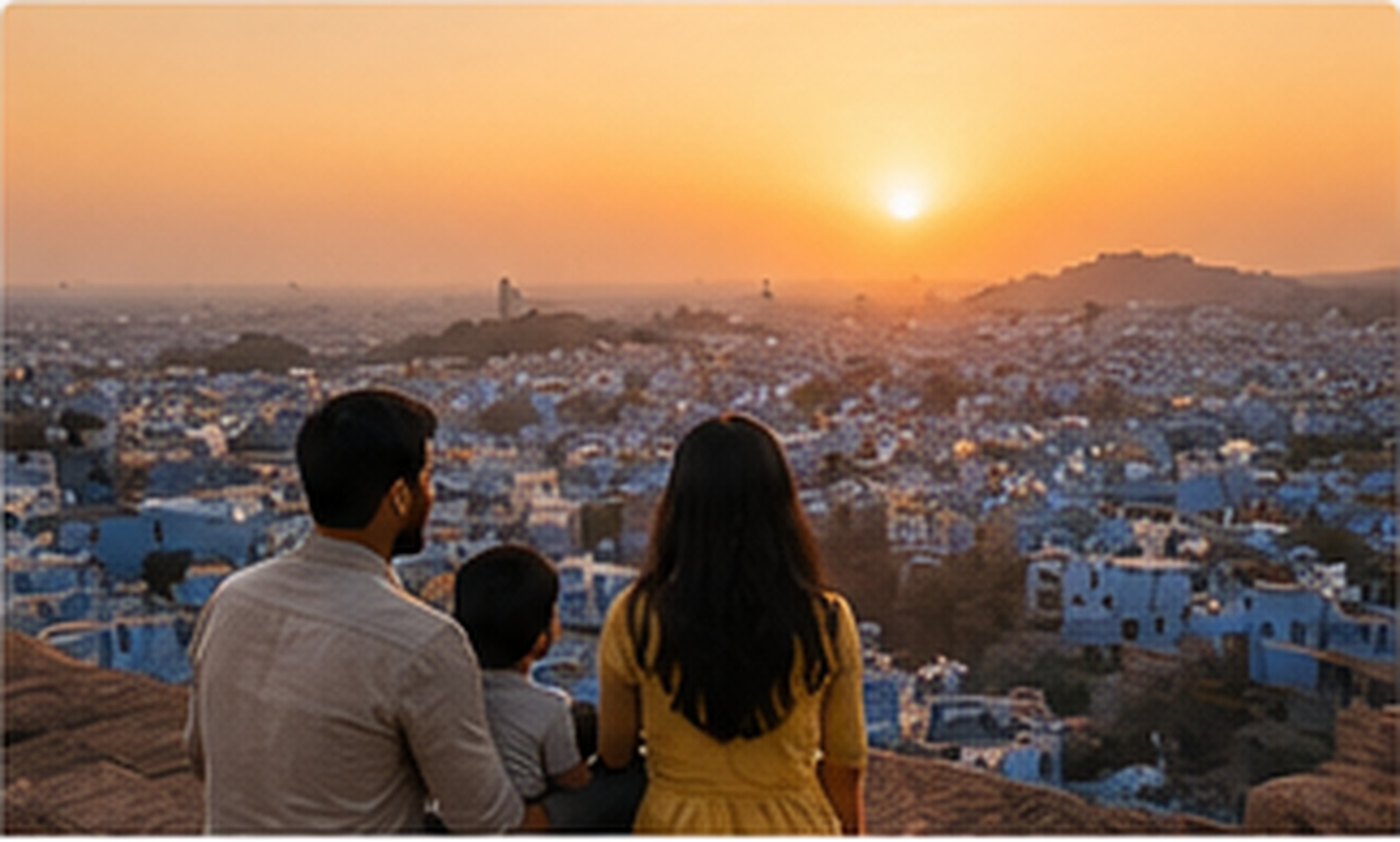
The blue goes violet, then grey, then lamp-lit. — our own frame, shot to this direction.
SHOT 10 OF 12 · THE SUNSET
The Light Changes
The one hour the city changes colour: the blue goes violet, then grey, then lamp-lit. The photograph everyone wants and almost nobody plans for.
The place
A west-facing viewpoint — Pachetia Hill, the free viewpoint above Sodagaran Mohalla, reached on foot up through the Navchokiya lanes; Singhvi's Haveli rooftop in Navchokiya; or Jharokha 360 at The Stepwell Hotel above Toorji Ka Jhalra
Stand here
At the rooftop's western edge, the sun ahead of you and the rooftops falling away below. Your family stands at the parapet, slightly to one side, watching it.
People
Yours, silhouetted, looking at the sunset — not the camera.
The light
The sun sets to the west over the blue city; the last hour turns the rooftops gold and the family into silhouettes. If cloud steals the glow, wait — the ten minutes after the sun goes are often the best colour.
THE LAST HOUR BEFORE SUNSET Oct–Nov ≈ 5:00pm – 5:35pm · Dec–Jan ≈ 4:55pm – 5:30pm · Feb–Mar ≈ 5:35pm – 6:10pm
Pachetia Hill is about 20 minutes on foot up through the Navchokiya lanes — ask locally, GPS is unreliable. Rao Jodha Rock Park does not work for this one: it is ticketed and the gate shuts at 17:30 in season, before the sun goes.
The frame
Sun low, rooftops to the horizon, your family at the edge of the frame in silhouette, watching it. Tap the sky — not the people — so the colour stays rich and they stay dark.
Landscape orientation, main lens (1×). Don't zoom — the width is the point.
Did our direction work?CURATED · NOT YET FIELD-CHECKED
Back through the lanes, slower now. — our own frame, shot to this direction.
SHOT 11 OF 12 · THE EVENING WALK
The Lanes at Dusk
The monuments close at five; the city doesn't. The hour after sunset is when Jodhpur belongs to the people who live in it — and when your family, walking through it with nowhere to be, becomes part of it.
The place
The old-city lanes in the half hour after sunset — Navchokiya, Makrana Mohalla, or Tambaku Bazaar between Sardar Market and the stepwell
Stand here
Five paces behind your family as they walk ahead of you down a lane. Don't call them; let them walk. Stop where the lane narrows or bends ahead of them.
People
Yours — this is the frame that will mean the most in ten years. Residents in the lane stay incidental; never photograph anyone close-up without asking.
The light
Blue hour: the sky still holds colour, the lamps are on, and the lanes go soft and even. Full dark is too late — the sky goes black and the lamps burn out.
THE HALF HOUR AFTER SUNSET — BLUE HOUR, LAMPS ON Oct–Nov ≈ 6:12pm – 6:40pm · Dec–Jan ≈ 6:07pm – 6:35pm · Feb–Mar ≈ 6:47pm – 7:15pm
The frame
Backs to the camera, hand in hand, the lane narrowing ahead. Night mode on, elbows in, hold still, and shoot when they are mid-step.
Portrait orientation, main lens (1×), night mode on. Brace an elbow against a wall.
Did our direction work?CURATED · NOT YET FIELD-CHECKED
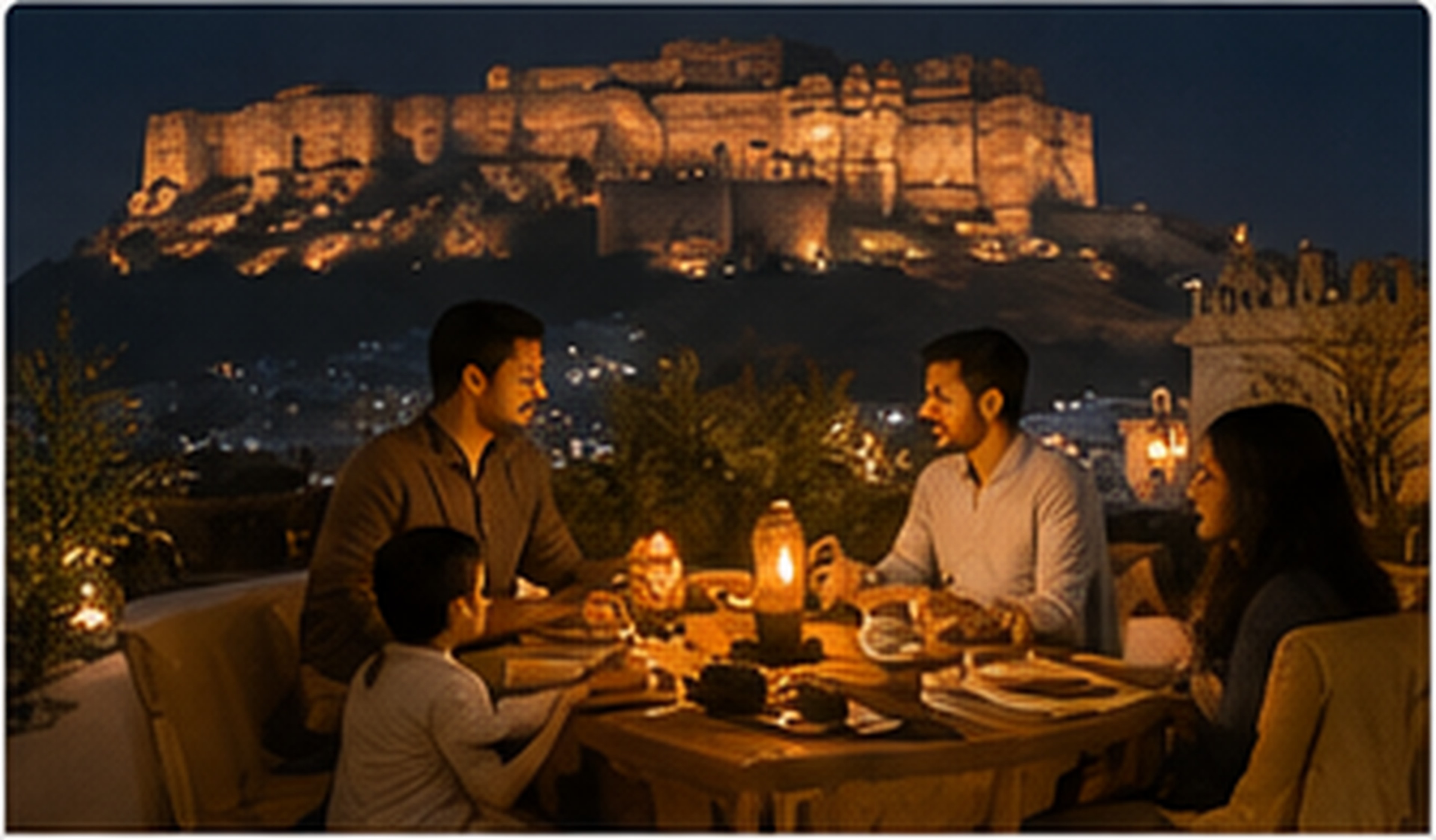
The trip ending. The fort continuing. — our own frame, shot to this direction.
SHOT 12 OF 12 · THE LAST EVENING
The Last Evening
The closing image: the fortress floodlit above the rooftops, keeping watch as it has since 1459 — with the edge of your table in the frame, because you were here.
The place
A fort-view rooftop — Indique at Pal Haveli (the classic angle over the clock tower), Darikhana or the Baradari at RAAS under the walls, or Jharokha 360 at The Stepwell Hotel
Stand here
Book a fort-view rooftop for your last dinner. Sit facing the fort; shoot from your seat with the table's edge — a glass, a plate, a candle — in the lower frame.
People
Optional: one of you at the table's edge, out of focus, fort sharp beyond. The trip ending, the fort continuing.
The light
Blue hour into night: the sky holds colour for half an hour after sunset while the floodlights warm the walls. That overlap is the window.
15 TO 60 MINUTES AFTER SUNSET — FLOODLIGHTS ON, SKY STILL BLUE Oct–Nov ≈ 6:45pm – 7:30pm · Dec–Jan ≈ 6:40pm – 7:25pm · Feb–Mar ≈ 7:20pm – 8:05pm
Confirm the fort's lights are on that evening when you book the table — outages happen.
The frame
Table edge low and soft in frame, rooftops dark in the middle, the lit fort above against deep blue. Brace the phone on the table edge or a water glass; night mode on.
Portrait orientation, main lens (1×), night mode. Wipe the lens — dinner-table phones carry fingerprints.
Did our direction work?CURATED · NOT YET FIELD-CHECKED
Twelve photographs become your book
Capture the twelve and your album — My Jodhpur — assembles itself in narrative order. Back home, one tap: Create My Book. Your photographs, this guide’s story, printed and bound.